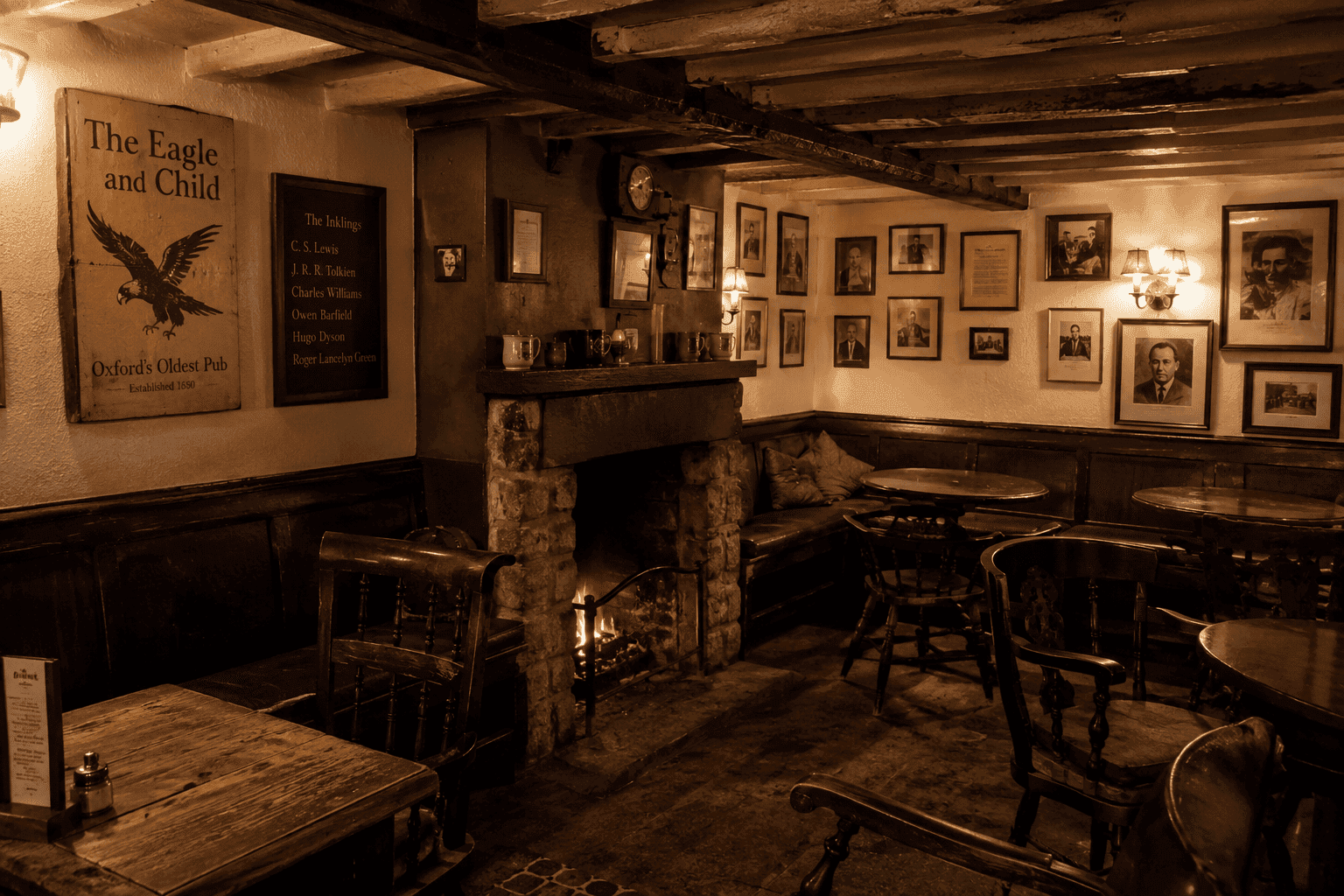
Where Middle-earth Was First Read Aloud
Push open the narrow timber door at 49 St Giles’ and you step into one of the great surviving shrines of twentieth-century literature. The Eagle and Child — affectionately known across Oxford as the Bird and Baby — was never intended to become legendary. It was a modest public house with low ceilings, dark beams, smoke-stained walls and cramped back rooms where dons escaped the rituals of college life for beer, argument and companionship. Yet within those rooms, some of the modern world’s most beloved stories were first given breath.
Here, beneath the murmur of lunchtime drinkers and the clink of pint glasses, J.R.R. Tolkien read sections of a sprawling fantasy epic still unfinished and uncertain. C.S. Lewis circulated early proofs of The Lion, the Witch and the Wardrobe before generations of children discovered Narnia through wardrobe doors and lamplit snow. Around them gathered poets, scholars, theologians and novelists who would come to be known collectively as the Inklings, one of the most influential literary circles in modern history.
These were not polished literary salons. There was no applause, no velvet curtain, no sense that literary immortality was taking shape over ale and tobacco smoke. Manuscripts arrived rough, incomplete and vulnerable. Chapters were interrupted mid-sentence by criticism, laughter or brutal honesty. The atmosphere was closer to a workshop than a performance. Yet it was precisely this frankness — this willingness to expose unfinished imagination to trusted friends — that helped forge works which would go on to shape fantasy literature for the next century.
The Bird and Baby and the Strange Alchemy of Oxford
The Eagle and Child dates back at least to 1684, its name appearing in surviving records from the late seventeenth century. The pub sign — an eagle carrying an infant in its talons — belongs to an older heraldic tradition tied to the Stanley family and the Earls of Derby, though legends surrounding the image drift into mythology: noble children discovered in nests, echoes of Ganymede carried skyward by Zeus, fragments of medieval storytelling surviving in pub iconography.
For centuries the building formed part of the estate of University College Oxford before later passing to St John’s College Oxford. Today the pub belongs to the Ellison Institute of Technology, which has pledged to preserve its historic character during restoration, including the famed Rabbit Room where the Inklings once gathered.
Architecturally, the pub remains quintessentially Oxford: timber-framed, intimate, slightly uneven with age, its narrow corridors and crooked rooms shaped by centuries rather than design trends. Standing on St Giles’ — one of the city’s grandest avenues — it occupies the intellectual heart of Oxford, only moments from the colleges, libraries and quadrangles that produced generations of writers, historians and philosophers.
The Inklings: Oxford’s Most Famous Literary Brotherhood
The Inklings were never formally established. There were no membership cards, no constitutions, no official records. As Warren Lewis later observed, the group was “neither a club nor a literary society, though it partook of the nature of both.” It emerged organically in the early 1930s among academics orbiting Lewis and Tolkien, men bound together by literature, mythology, Christianity, philology and the conviction that myth still possessed enormous spiritual power in the modern world.
The core members included Tolkien, Lewis, Warren Lewis, Charles Williams, Owen Barfield, Hugo Dyson, Robert Havard and others who drifted through Oxford’s literary orbit during the period.
Their most famous meetings took place on Thursday evenings in Lewis’s rooms at Magdalen College Oxford. There, above the deer park and cloisters, unfinished works were read aloud while criticism flowed as freely as beer. Tolkien’s readings from The Lord of the Rings became legendary among the group, though not always universally adored. Hugo Dyson, exhausted by Tolkien’s increasingly detailed mythology, is reputed to have muttered, “Oh no, not another elf.”
Yet the Inklings were far more than a fantasy-writing society. Academic essays, poetry, theology, translations and literary criticism all circulated among them. They debated language, myth, morality, Christianity and the purpose of storytelling itself. They also indulged in gleeful absurdities, including competitions to read the notoriously dreadful prose of Amanda McKittrick Ros without collapsing into laughter.
The Rabbit Room and the Birth of Modern Fantasy
If Magdalen hosted the formal readings, the Eagle and Child supplied the atmosphere. The Inklings’ Tuesday lunchtime meetings in the pub’s back room — later immortalised as the Rabbit Room — became part of Oxford folklore. The room itself was small, warm and enclosed, the sort of place where winter light barely penetrated and conversations lingered for hours.
It was here, in June 1950, that Lewis handed around proofs of The Lion, the Witch and the Wardrobe. It was here Tolkien discussed Middle-earth while still wrestling with its immense scope and structure. Long before fantasy became a dominant commercial genre, these stories existed only as manuscripts shared between friends over lunch.
The importance of those meetings cannot be overstated. Tolkien’s concept of mythopoeia — the creation of entirely imagined mythological worlds — found encouragement among the Inklings when few others understood what he was attempting. Lewis’s apologetics, science fiction and fantasy developed under similar scrutiny and support. The group functioned simultaneously as critics, first readers, intellectual sparring partners and emotional reinforcement.
Without the Inklings, modern fantasy literature might look profoundly different.
From the Eagle and Child to the Lamb and Flag
In 1962 the Eagle and Child underwent renovation. The alterations removed much of the Rabbit Room’s privacy, opening it into the wider pub and disrupting the atmosphere that had sustained the group for years. The Inklings shifted their meetings across the road to The Lamb and Flag, another ancient Oxford pub with its own rich academic history.
The Lamb and Flag, dating to at least 1695, derived its name from the emblem of St John the Baptist and long operated under the ownership of St John’s College, whose students benefited from its profits through scholarship funding. Yet by the early 1960s the Inklings themselves were fading. Tolkien and Lewis, once inseparable intellectual companions, had gradually drifted apart. Lewis’s marriage to Joy Davidman altered his social world, while Tolkien became increasingly isolated within his own scholarly pursuits.
Lewis died on 22 November 1963 — the same day as the assassination of John F. Kennedy — and with him the spirit of the group largely disappeared. Tolkien survived until 1973, but the era of the Inklings had already passed into literary history.
Oxford: A City Built on Conversation
Oxford’s literary pub culture was never accidental. For centuries, colleges functioned as highly formal and often socially restrictive environments. Pubs became the city’s democratic spaces — places where professors, students, journalists, poets and townspeople could exist on something approaching equal footing.
The Eagle and Child was only one part of a much wider culture. The King’s Arms became another gathering point for academics and students. The Turf Tavern hid itself away behind narrow alleyways near Brasenose College. The Bear Inn claimed origins stretching back to 1242 and filled its walls with neckties from centuries of visitors. During wartime beer shortages, the Inklings occasionally migrated between pubs, carrying their discussions across the city’s ancient streets.
These establishments offered something the colleges rarely could: warmth, informality and human closeness. Ideas moved more freely over pints than they ever did beneath vaulted ceilings and formal gowns.
The Legacy of the Inklings
The literary impact of the Inklings borders on the immeasurable. The Lord of the Rings helped establish the modern fantasy genre and has sold more than 150 million copies worldwide. The Chronicles of Narnia became foundational children’s literature across generations. The theological and philosophical works of Lewis continue to shape Christian thought and literary criticism alike. Charles Williams influenced writers including T.S. Eliot and W.H. Auden.
Yet perhaps the Inklings’ greatest lesson lies not in the books themselves but in the model they offered. Great literature rarely emerges in total isolation. It grows through conversation, disagreement, encouragement and the courage to expose unfinished ideas to trusted minds. The Rabbit Room was not merely a pub back room. It was a forge for imagination.
Today, though the Eagle and Child remains under restoration, pilgrims still arrive from around the world hoping to stand where Tolkien and Lewis once argued about mythology and language. The physical room survives because the stories born there escaped Oxford entirely. They travelled beyond England, beyond academia, beyond literature itself, entering global culture as modern myths.
And on winter evenings along St Giles’, when mist settles beneath the college lamps and the bells echo across the rooftops, Oxford still feels haunted by the figures who once crossed the street toward the Bird and Baby: a philologist inventing Elvish languages in his head, a Christian apologist imagining wardrobes opening into snowbound kingdoms, and a gathering of writers who transformed pub conversation into immortality.